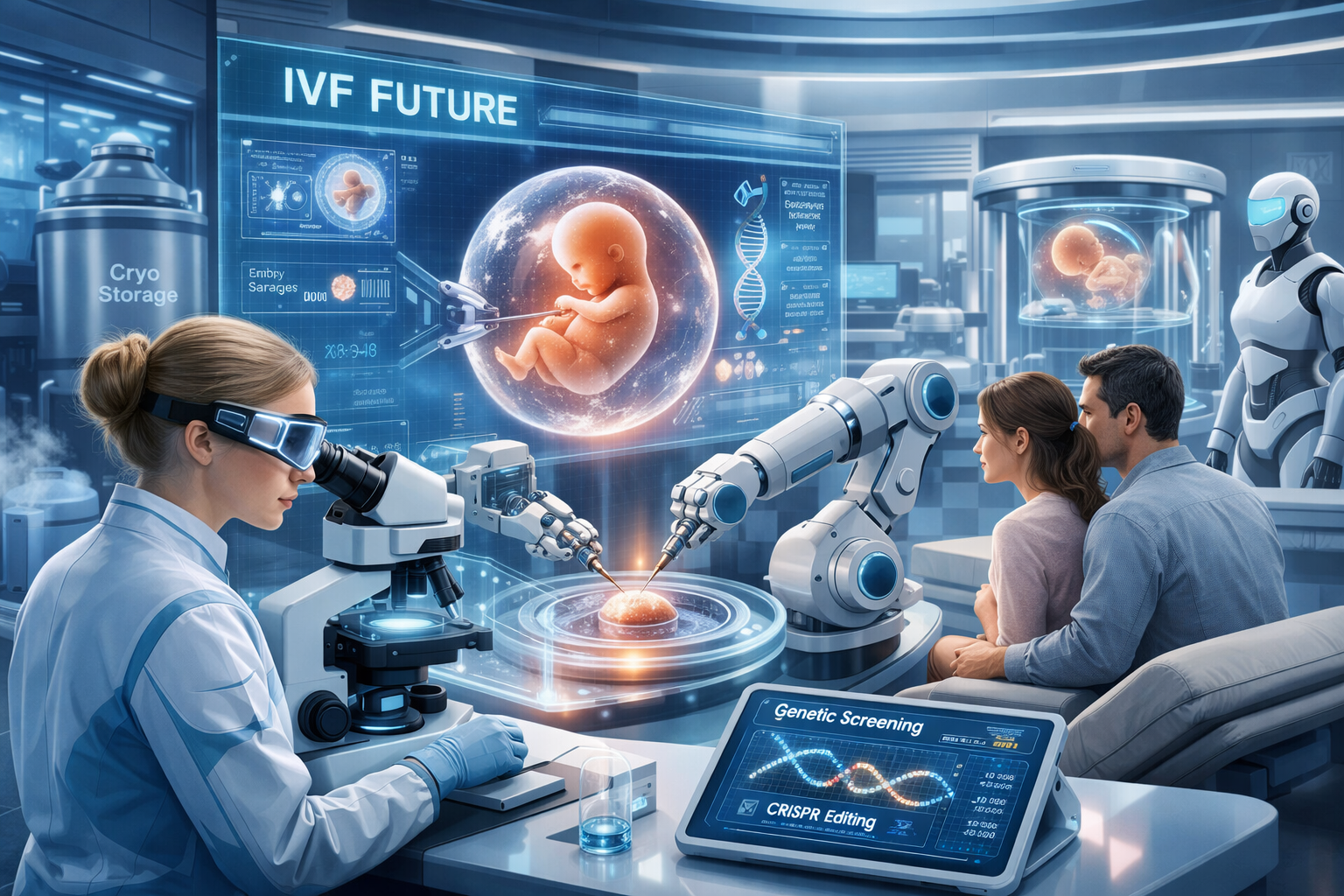
 IVF in the future is expected to become safer, more precise, more personalized, and less physically and emotionally demanding. Many of the changes are already happening gradually. Here’s a clear picture of what IVF is likely to look like over the next 5–20 years:
- More Personalized & AI-Driven Treatment
- AI algorithms will analyze age, hormones, genetics, ovarian response, sperm quality, and past cycles to design fully individualized stimulation protocols.
- Medication doses and timing will be optimized in real time.
- This will reduce failed cycles, side effects, and unnecessary medication.
- Smarter Embryo Selection (Beyond the Microscope)
- AI-based time-lapse systems will predict implantation potential more accurately.
- Non-invasive genetic testing (from embryo culture media instead of biopsy) may reduce or replace embryo biopsy.
- Metabolomic and proteomic analysis will help identify the healthiest embryos.
- Elimination of Ovarian Hyperstimulation Syndrome (OHSS)
- Freeze-all strategies will become standard.
- New stimulation drugs and triggers will further lower OHSS risk.
- IVF will increasingly separate egg retrieval and embryo transfer into safer stages.
- More Natural & Gentle IVF
- Mild stimulation protocols will be more common.
- Some patients may undergo IVF with very low medication or even natural-cycle IVF combined with AI embryo selection.
- Fewer injections, fewer side effects, less stress.
- Improved Cryopreservation & “IVF on Demand”
- Egg, sperm, and embryo survival after freezing will approach near 100%.
- Patients may complete stimulation in one country and transfer embryos in another with ease.
- “Bank now, transfer later” will be routine.
- Genetics & Prevention (Carefully Regulated)
- Better detection of embryos with high implantation and live-birth potential.
- Reduced miscarriage rates due to improved chromosomal screening.
- Ethical boundaries will remain strict (no “designer babies”).
- Gene editing: CRISPR and other gene-editing technologies may be used to correct genetic problems in embryos before transfer to eliminate the risk of many hereditary conditions. However, this technology will probably face many different ethical and regulatory limitations before routine use.
- Higher Cumulative Success, Fewer Twins
- Single embryo transfer will become the norm.
- Cumulative pregnancy rates (after using frozen embryos) may exceed 80–90% in young patients.
- More intelligent 🧠
- Safer 🛡️
- More patient-friendly 🌱
- More successful 📈
Tags: ivf ivf chat gpt ivf future